Posts

Image
The global market for Coffee Shops is projected to reach US$237.6 billion by 2025, driven by the silent importance and role by them in our society. Coffee is the second most popular beverage after water. Not surprisingly coffee performs a very important social function and plays a vital role in building social relationships. Since coffee consumption transcends geographic and cultural boundaries, it widely considered as a social lubricant helping people bond, communicate, build relationships and enjoy. Given the pleasurable experience of coffee consumption, coffee shops have become social places for people to handout, talk, write, read, and study. It provides a cozy intimate living room atmosphere for causal customers reading a book; a connected environment with free-Wi-Fi for busy customers on a laptop; a cheerful environment for socializing friends; offers a romantic environment for dating couples.    Coffee shops have therefore become icons of urban neighborhoods. They...
Image
The global market for Affective Computing is projected to reach US$131 billion by 2025, driven by growing awareness over the real importance of emotion in advancing the capability of artificial intelligence (AI) technology. Given that human decision making processes is a complex combination of cognitive functions and emotional, also known as affective functions, machines will need to understand and respond to human emotions in order to function effectively, efficiently and safely alongside humans. Emotional intelligence is therefore the next logical step in the evolution of AI based machines in order to help humans fully realize the many benefits of the technology. Few the factors which indicate affective computing as ripe for commercial growth include rapid proliferation of AI and the continuous quest for emotionally responsive AI for a more natural interaction between humans and machines; need for emotion-detection and emotion intelligence becomes more important than ever as AI...
Image
The global Die Casting market is projected to reach US$94.1 billion by 2025, driven by the growing demand for lightweight yet high performance components in industries ranging from electronics, lighting, automotive, aircraft, telecommunications, medical equipment, and hydraulics, among others. Die Casting, over the decades, has emerged into a widespread and extremely popular metal forming and processing process for producing metal parts. Defined as a process wherein molten metal is poured into a die-casting mold using high pressure, die-casting offers numerous advantages such as enabling high-speed production; ability to produce complex geometric shapes with precision; eliminates the need for machining; reduces material wastages; high degree of dimensional accuracy and stability; die-cast parts are heat resistant and have higher mechanical strength than plastic injection moldings; enables smooth or textured metal finishing; ability to be easily electroplated with little or no su...
Image
The global Industrial Chocolate market is projected to reach US$62 billion by 2025, driven by the robust popularity of affordable, mass-produced confections. Industrial chocolates have made chocolates an affordable luxury. Chocolates have emerged to be one of the most successful foods in human history. Humans and chocolates have a long and serious history that dates back 5000 years to the Mayo-Chinchipe culture. Today, chocolates have evolved from being the food of the rich to the masses, a modest luxury for all to enjoy. Industrialization of chocolates has largely helped achieve this. Economies of scale stemming from large scale procurement of cocoa and automation of the manufacturing process from cacao bean to the final chocolate bar have helped reduce price of chocolates. Unlike boutique chocolates, industrial chocolates are manufactured with quality that is consistent and repeatable. Today, demand for cheap yet high quality chocolate continues to be high with chocolate making ...
Image
The global Continuous Renal Replacement Therapy (CRRT) market is projected to reach US$1.5 billion by 2025, driven by the growing incidence of acute kidney injury (AKI) and the resulting rise in hemodynamically unstable patients. Few of the factors leading to AKI include sudden blockage of urine due to enlarged prostrate or kidney stones; kidney toxicity caused by medications; autoimmune kidney diseases such as acute nephritic syndrome and interstitial nephritis; and accidental trauma or injury to the kidneys. The aging population and the increase in the number of hospitalized elderly are also pushing up the incidence of AKI. This is because older patients in ICU with high blood pressure, chronic liver or heart diseases are at a high risk of having AKI. Benefits of CRRT driving its acceptance as a standard practice for hemodynamically unstable ICU patients include the continuousness of the therapy is physiologically similar to a normal kidney and is therefore safe and effective; ...
Image
The global Airport Construction market is projected to reach US$1.4 trillion by 2025, driven by growing government focus on building infrastructure which is key to economic growth and societal evolution. While governments in developed countries are investing predominantly for infrastructure replacement and upgrades, in developing countries investments are directed towards the creation of new infrastructure. The new budgetary focus on infrastructure comes at a time when infrastructure around the world is collapsing as a result of chronic underfunding of critical infrastructure. Posed to benefit in this regard is airport infrastructure. The global aviation industry has evolved considerably over the years and is currently regarded as a key barometer of the economic health of a nation. Airports and airlines link countries and cities across the globe facilitating worldwide trade, business trips, and tourism, all of which are of great importance to the economic prosperity of a given nat...
Image
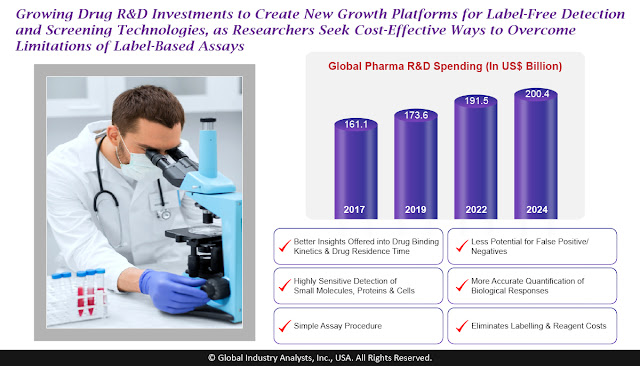
The global Label-Free Detection market is projected to reach US$1.3 billion by 2025, driven by growing drug R&D, rising competitive pressure to reduce cost of drug development and the resulting need for cost-effective and efficient screening technologies. Traditional label-based assays are beset with drawbacks such as high cost associated with label preparation; lower levels of sensitivity and accuracy as measurements are made indirectly using a labeled reactant; risk of certain antigen/antibody reactions not being detected; requires multiple steps and is time consuming; and tendency to modify the physicochemical or binding properties making accurate drug characterization difficult. In this regard, label-free assays for biochemical and cell-based drug discovery is growing in importance due to the many benefits offered such as ability to identify difficult target classes, better insights offered into drug binding kinetics and drug residence time; highly sensitive detection of ...